
|
Generated on 4/2/2026 at 1:40 PM |
https://www.cpalms.org/PreviewStandard/Preview/15348
Multiply two whole numbers, each up to two digits, including using a standard algorithm with procedural fluency.
Connecting Benchmarks/Horizontal Alignment
Terms from the K-12 Glossary
- Expression
- Equation
- Factor
Vertical Alignment
Previous Benchmarks
Next Benchmarks
Purpose and Instructional Strategies
The purpose of this benchmark is for students to become procedurally fluent in using a standard algorithm. Work with standard algorithms began in the procedural reliability stage when students explored a variety of methods and learned to use at least one of those methods accurately and reliably. To demonstrate procedural fluency, students may choose a standard algorithm that works best for them. A standard algorithm is a method that is efficient and accurate (MTR.3.1). A standard algorithm is also generalizable, meaning that it works no matter how many digits are involved.
- It is important to challenge students to explain the steps they follow when using a standard algorithm (i.e. regrouping, proper recording and placement of digits by place value). For example, when students use a standard algorithm, they should be able to justify why it works conceptually. Teachers can expect students to demonstrate how their algorithm works, for example, by comparing it to another method for multiplication (MTR.6.1).
- Along with using a standard algorithm, students should estimate reasonable solutions before solving. Estimation helps students anticipate possible answers and evaluate whether their solutions make sense after solving.
- This benchmark supports students as they solve multi-step real-world problems involving combinations of operations with whole numbers (MA.4.AR.1.1).
Common Misconceptions or Errors
- Students that are taught a standard algorithm without any conceptual understanding will often make mistakes. For students to understand a standard algorithm or any other method, they need to be able to explain the process of the method they chose and why it works. This explanation may include pictures, properties of multiplication, decomposition, etc. Students may make computational errors while using standard algorithms when they are unable to reason why their algorithms work.
- Some students may struggle with this benchmark if they do not have a strong command of basic addition and multiplication facts.
Strategies to Support Tiered Instruction
- Instruction includes explaining mathematical reasoning while using a multiplication algorithm. Instruction also includes determining if an algorithm was used correctly by reviewing the reasonableness of solutions.
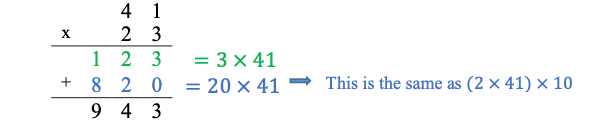
- For example, students use an algorithm to determine 41 × 23 and explain their thinking using place value understanding. Explicit instruction includes: “Begin by multiplying 3 ones times 1 one. This equals 3 ones. We will write the 3 ones under the line, in the ones place. Next, we will multiply 3 ones times 4 tens. This equals 12 tens. We will write the 12 tens under the line in the hundreds and tens place because 12 tens is the same as 1 hundred and 2 tens. This gives us our first partial product of 123. Now we will multiply the 1 one by the 2 tens from 23. This equals 2 tens or 20. We will record 20 below our first partial product of 123. Next, we, we will multiply 2 tens times 4 tens, which equals 8 hundreds. We will write the 8 in the hundreds place of our second partial product. Our second partial product is 820. Finally, we add our partial products to find the product of 943.”
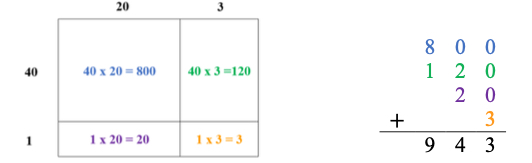
- For example, students determine 41 × 23 using an area model and place value understanding.
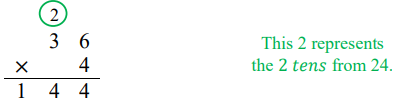
- For example, students use an algorithm to determine 4 × 36 and explain their thinking using place value understanding. Instruction includes stating, “Begin by multiplying 4 ones times 6 ones. This equals 24 ones or 2 tens and 4 ones. We will write the 4 ones from 24 under the line, in the one's place. We will write the 2 tens from 24 as a 2 above the 3, as a regrouped digit in the tens place. Next, we will multiply 4 ones times 3 tens. This equals 12 tens. We will add the 2 tens to the 12 tens for a total of 14 tens. We will write the 14 tens under the line in the hundreds and tens place because 14 tens is the same as 1 hundred and 4 tens. Our product is 144.”
- For example, students determine 4 × 36 using an area model and place value understanding.

- Instruction includes the use of known facts to find unknown multiplication facts.
- For example, if the student does not know the product for 4 × 6 from the previous 120 +24 144 example, have students use a known fact such as 4 × 5. The known fact of 4 × 5 = 20 can be used to find the product of 4 × 6 by adding one more group of 4 to the product of 20 to find the product of 24.
Instructional Tasks
Instructional Task 1 (MTR.4.1, MTR.5.1)
Using the digits 1, 2, 3 and 4, arrange them to create two 2-digit numbers that when multiplied, will yield the greatest product.
Instructional Task 2
Part A. Solve using an area model or the distributive property.
Part B. Solve using a standard algorithm.
Part C. Explain the relationship between your partial products from Part A and your partial products from Part B.
Instructional Items
Instructional Item 1
Select the expressions that have a product of 480.
- a. 10×48
- b. 16×30
- c. 24×24
- d. 32×15
- e. 40×80
Instructional Item 2
A multiplication problem is shown.
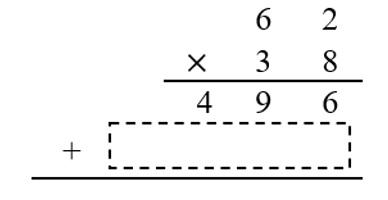
Part A. What is the missing value in the box in the problem shown?
Part B. What is product of 38 X 62?
*The strategies, tasks and items included in the B1G-M are examples and should not be considered comprehensive.
- Grade Four Mathematics (Specifically in versions: 2014 - 2015, 2015 - 2022, 2022 - 2024, 2024 and beyond (current)) 5012060
- Access Mathematics Grade 4 (Specifically in versions: 2014 - 2015, 2015 - 2018, 2018 - 2022, 2022 and beyond (current)) 7712050
- Grade 4 Accelerated Mathematics (Specifically in versions: 2019 - 2022, 2022 - 2024, 2024 and beyond (current)) 5012065
- Foundational Skills in Mathematics 3-5 (Specifically in versions: 2019 - 2022, 2022 - 2024, 2024 and beyond (current)) 5012015
- MA.4.NSO.2.AP.3 Apply a strategy to multiply two whole numbers up to two digits by one digit.
- The Produce Shop Students are asked to multiply a pair of two-digit numbers using a strategy based on place value.
- Model Multiplication This concept based, hands-on lesson is intended to help you assess how well your students understand and can use a variety of strategies and representations of 2 two-digit multiplication.
- Oops! What did I do? This lesson uses a discovery approach to exploring different errors in various strategies of multiplication. The goal is to help students understand multiplication, not force them into using every strategy.
- Chance Product Are you trying to deepen your students understanding of 2-digit by 2-digit multiplication? Then this is the game for you. This game allows students to demonstrate their abilities in multiplication and reasoning. Students will place numbers drawn onto a recording sheet in order to create the greatest product possible.
-
Patty's Party Planning In this Model Eliciting Activity, MEA, students will help a party planner determine which party location is the best one to use. They will calculate the cost of the banquet hall rental based on the number of people, number of tables and hourly rental of the location by using division and multiplication.
Model Eliciting Activities, MEAs, are open-ended, interdisciplinary problem-solving activities that are meant to reveal students’ thinking about the concepts embedded in realistic situations. MEAs resemble engineering problems and encourage students to create solutions in the form of mathematical and scientific models. Students work in teams to apply their knowledge of science and mathematics to solve an open-ended problem, while considering constraints and tradeoffs. Students integrate their ELA skills into MEAs as they are asked to clearly document their thought process. MEAs follow a problem-based, student centered approach to learning, where students are encouraged to grapple with the problem while the teacher acts as a facilitator. To learn more about MEA’s visit: https://www.cpalms.org/cpalms/mea.aspx
- Playground Protection In this Model Eliciting Activity, MEA students will decide which type of protective surface should be put in under a new playground unit. They will consider many factors before ranking their decisions about the best surface. Model Eliciting Activities, MEAs, are open-ended, interdisciplinary problem-solving activities that are meant to reveal students’ thinking about the concepts embedded in realistic situations. Click here to learn more about MEAs and how they can transform your classroom.
- Multi-Digit Multiplication Strategies Explore different strategies students may use when solving multi-digit multiplication problems and ways you can support their understanding in this video. FCR-STEM’s Count Us In! initiative is designed to support out-of-school providers and parents in fostering math success and enjoyment among K-5 children.
- Fluency vs. Automaticity How are fluency and automaticity defined? Dr. Lawrence Gray explains fluency and automaticity in the B.E.S.T. mathematics benchmarks in this Expert Perspectives video.
- The Role of Procedures in Fluency What are the components to a good procedure? Dr. Lawrence Gray discusses the role of procedures in the path to fluency in this Expert Perspectives video.
- That's Not How I Learned it: Why today's math may look different Why do students need "a" good procedure for the arithmetic operations? Dr. Lawrence Gray explains why math may look different than in the past in this Expert Perspectives video.
- B.E.S.T. Journey What roles do exploration, procedural reliability, automaticity, and procedural fluency play in a student's journey through the B.E.S.T. benchmarks? Dr. Lawrence Gray explains the path through the B.E.S.T. mathematics benchmarks in this Expert Perspectives video.
- What is Fluency? What is fluency? What are the ingredients required to become procedurally fluent in mathematics? Dr. Lawrence Gray explores what it means for students to be fluent in mathematics in this Expert Perspectives video.
- Why Isn't Getting the "Right" Answer Good Enough? Why is it important to look beyond whether a student gets the right answer? Dr. Lawrence Gray explores the importance of understanding why we perform certain steps or what those steps mean, and the impact this understanding can have on our ability to solve more complex problems and address them in the context of real life in this Expert Perspectives video.
- A Standard Algorithm Ever wonder why the benchmarks say, “a standard algorithm,” instead of, “the standard algorithm?" Dr. Lawrence Gray explores the role that standard algorithms can play in building and exhibiting procedural fluency through this Expert Perspectives video.
- Connecting Area to Multiplication Using the Area Model This video explores how the area model supports students' understanding of multiplication by connecting it to place value, proportional reasoning, and real-world contexts. It emphasizes the importance of visual structure and flexibility in decomposition to build conceptual understanding and fluency.
- Number Sense and Operations Guide for Providers: Best Practices For K–5 Mathematics Support During Out-Of-School Time This guide offers five practical strategies to help after-school providers support meaningful, low-pressure math experiences that lead to deeper understanding and better long-term outcomes for K-5 students' Number Sense and Operations.
- Multiplying: how to use the area model In this video tutorial from Khan Academy, view a demonstration of how to set-up an area model for multiplying a two-digit number by a two-digit number on graph or grid paper and then link this to the standard algorithm.
- Multiplying: 2-digit number times a 2-digit number (area model) In this tutorial video from Khan Academy, view an example of how to multiply a two-digit number by a two-digit number using the area model. The video makes a connection between partial products and the area model.
- Multiplying: 2-digit number times a 2-digit number (standard algorithm) In this tutorial video from Khan Academy, view an example of how to multiply a 2-digit number by another 2-digit number. Be sure to stick around for the second example! The key is understanding the value of each digit!
- Multiplying: 3 digits times 1 digit (standard algorithm) In this video tutorial from Khan Academy, view an example of how to solve a problem in which a 3-digit number is being multiplied by a 1-digit number using the standard algorithm.
- Multiplying: 2 digits times 1 digit (standard algorithm) In this video tutorial from Khan Academy, view an example of how to solve a multiplication problem with a two-digit number multiplied by a one-digit number using the standard algorithm.
-
Patty's Party Planning In this Model Eliciting Activity, MEA, students will help a party planner determine which party location is the best one to use. They will calculate the cost of the banquet hall rental based on the number of people, number of tables and hourly rental of the location by using division and multiplication.
Model Eliciting Activities, MEAs, are open-ended, interdisciplinary problem-solving activities that are meant to reveal students’ thinking about the concepts embedded in realistic situations. MEAs resemble engineering problems and encourage students to create solutions in the form of mathematical and scientific models. Students work in teams to apply their knowledge of science and mathematics to solve an open-ended problem, while considering constraints and tradeoffs. Students integrate their ELA skills into MEAs as they are asked to clearly document their thought process. MEAs follow a problem-based, student centered approach to learning, where students are encouraged to grapple with the problem while the teacher acts as a facilitator. To learn more about MEA’s visit: https://www.cpalms.org/cpalms/mea.aspx
- Playground Protection In this Model Eliciting Activity, MEA students will decide which type of protective surface should be put in under a new playground unit. They will consider many factors before ranking their decisions about the best surface. Model Eliciting Activities, MEAs, are open-ended, interdisciplinary problem-solving activities that are meant to reveal students’ thinking about the concepts embedded in realistic situations. Click here to learn more about MEAs and how they can transform your classroom.
- The Produce Shop Students are asked to multiply a pair of two-digit numbers using a strategy based on place value.