Connecting Benchmarks/Horizontal Alignment
Terms from the K-12 Glossary
- Coordinate Plane
- Domain
- Function Notation
- Quadratic Function
- Range
- x-intercept
- y-intercept
Vertical Alignment
Previous Benchmarks
Next Benchmarks
Purpose and Instructional Strategies
In middle grades, students wrote linear two-variable linear equations. In Algebra I, students write quadratic functions from a graph, written description or table. In later courses, students will write quadratic two-variable inequalities.
- Instruction includes making connections to various forms of quadratic equations to show their equivalency. Students should understand when one form might be more useful than other depending on the context.
- Standard Form can be described by the equation y = ax2 + bx + c, where a, b and c are any rational number. This form can be useful when identifying the y-intercept.
- Factored Form can be described by the equation y = a(x − r1)(x − r2), where r1 and r2 are real numbers and the roots, or x-intercepts. This form can be useful when identifying the x-intercepts, or roots.
- Vertex Form can be described by the equation y = a(x − h)2 + k, where the point (h, k) is the vertex. This form can be useful when identifying the vertex.
- Instruction includes the use of x-y notation and function notation.
- Instruction includes the connection to completing the square and literal equations to rewrite an equation from standard or factored form to vertex form.
- Instruction includes comparing and contrasting between a linear function of the form y = a(x − h) + k and a quadratic function of the form y = a(x − h)2 + k. This will also extend to an absolute value function of the form y = a |x - h| + k. (MTR.5.1)
- When determining the value of a in a quadratic function, this can be done by two methods described below.
- Students may notice a pattern from the points in the graph. When a = 1, points 1 unit to the left or right of the vertex are 12 or 1 unit above or below the vertex. Points 2 units to the left or right of the vertex are (2)2 or 4 units above or below the vertex. Students may look at the table and notice this relationship exists, therefore, a = 1.
-
- This process can be used for other values of a. When a = 2, for example, points 1 unit to the left or right of the vertex are 2(12) or 2 units above or below the vertex. Points 2 units to the left or right of the vertex are 2(2)2 or 8 units above or below the vertex. Similarly, when a = 1⁄2 , points 1 unit to the left or right of the vertex are 1⁄2 (12) or 1⁄2 a unit above or below the vertex. Points 2 units to the left or right of the vertex are 1⁄2 (2)2 or 2 units above or below the vertex.
- Students can solve for a by substituting the values of x and y from a point on the parabola.
- Ask students to consider y = a(x + 4)2 − 2 and determine what information they would need to be able to solve for a. As students express the need to know values for x and for y, ask them if they know any combinations of x and y that are solutions. Students could use a table of values or a graph, if given, to determine values that could be used for x and y. Have students pick one and substitute and solve for a. Ask for students who chose different points to share their value for a to help them see that all points, when substituted, produce a = 1.
- Instruction includes the use of graphing software or technology.
- For example, when determining the value of a, consider using graphing software to allow students to use sliders to quickly observe this. This provides opportunity for students to notice patterns regarding the value of a and the concavity and stretch of the parabola (MTR.5.1).
Common Misconceptions or Errors
- When writing functions in vertex form, students may confuse the sign of h.
- For example, students may see a vertex of (−1, −2) and an a value of 3 and write the function as y = 3(x − 1)2 − 2 instead of y = 3(x + 1)2 − 2. To address this, help students recognize that because h is subtracted from x in vertex form, it will change the sign of that coordinate. Show students a graph of both functions to confirm and make the connection to transformation of functions (MA.912.F.2.1).
Strategies to Support Tiered Instruction
- Teacher emphasizes that because h is subtracted from x in vertex form, it will change the sign of that coordinate. For example, students may see a vertex of (-1,-2)and an a value of 3 and write the function as y = 3(x - 1)² -2 instead of y = 3(x + 1)² -2. Teachers could show students a graph (technology) of both functions to confirm and make the connection to transformation of functions (MA.912.F.2.1).
- Teacher models substituting roots into the factored form of a quadratic, y = a(x − r1)(x − r2). Instruction then includes reminding students of different methods that can be used to multiply binomials to convert the quadratic into standard form, y = ax2 + bx + c.
- Instruction includes solving for a by substituting the values of x and y from a point on the parabola. Students may need to review the order of operations to ensure they correctly isolate a. Provide students with a review of the order of operations.
- Parenthesis
- Exponents
- Multiplication or Division (Whatever comes first left to right)
- Addition or Subtraction (Whatever comes first left to right)
- Instruction includes recall of knowledge demonstrating how when h is subtracted from x in vertex form, it will change the sign of that coordinate. A graph of both functions can be used to confirm and make the connection to transformation of functions.
- Teacher provides a laminated cue card of the steps required to convert from factored form to standard form.
Instructional Tasks
Instructional Task 1 (MTR.7.1)
- Duane throws a tennis ball in the air. After 1 second, the height of the ball is 53 ft. After 2 seconds, the ball reaches a maximum height of 69 feet. After 3 seconds the height of the ball is 53 ft.
- Part A. Write a quadratic function to represent the height of the ball, h, at any point in time, t.
- Part B. How long will the tennis ball stay in the air? Round your answer to the nearest tenth second.
Instructional Task 2 (MTR.4.1, MTR.5.1)
- Part A. Create a quadratic function that contains the roots 3/5 and 1.8.
- Part B. Compare your function with a partner. What do you notice?
Instructional Items
Instructional Item 1
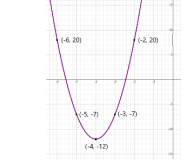
- Write the quadratic function that corresponds with the graph below.
Instructional Item 2
- Given the table of values below from a quadratic function, write an equation of that function.
Instructional Item 3
- Jayden launches a rocket from the ground that travels in a parabolic path until it lands. After two seconds it reaches a maximum height of 100 feet. The rocket is in the air for five seconds before it hits the ground. Write the quadratic function h(t), representing the height of the rocket above the ground after t seconds.
*The strategies, tasks and items included in the B1G-M are examples and should not be considered comprehensive.