MA.4.NSO.2.2

Multiply two whole numbers, up to three digits by up to two digits, with procedural reliability.
Clarifications
Clarification 1: Instruction focuses on helping a student choose a method they can use reliably.
Clarification 2: Instruction includes the use of models or equations based on place value and the distributive property.
Alternate version of this benchmark for students with significant cognitive disabilities.
Connecting Benchmarks/Horizontal Alignment
Terms from the K-12 Glossary
- Area Model
- Distributive Property
- Expression
- Equation
- Factor
Vertical Alignment
Previous Benchmarks
Next Benchmarks
Purpose and Instructional Strategies
The purpose of this benchmark is for students to choose a reliable method for multiplying 3 digit numbers by 2 digit numbers. It builds on the understanding developed in grade 3 (MA.3.NSO.2.2, MA.3.NSO.2.3, MA.3.NSO.2.4), builds on automaticity (MA.4.NSO.2.1) and prepares for procedural fluency (MA.4.NSO.2.3 and MA.5.NSO.2.1).
- For instruction, students may use a variety of strategies when multiplying whole numbers and use words and diagrams to explain their thinking (MTR.2.1). Strategies can include using base-ten blocks, area models, partitioning, compensation strategies and a standard algorithm.
- Using place value strategies enables students to develop procedural reliability with multiplication and transfer that understanding to division. Procedural reliability expects students to utilize skills from the exploration stage to develop an accurate, reliable method that aligns with their understanding and learning style.
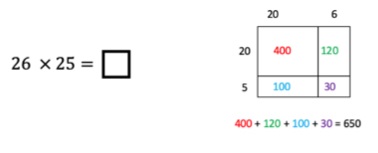
- The area model shows students how they can use place value strategies and the distributive property to find products with multi-digit factors.
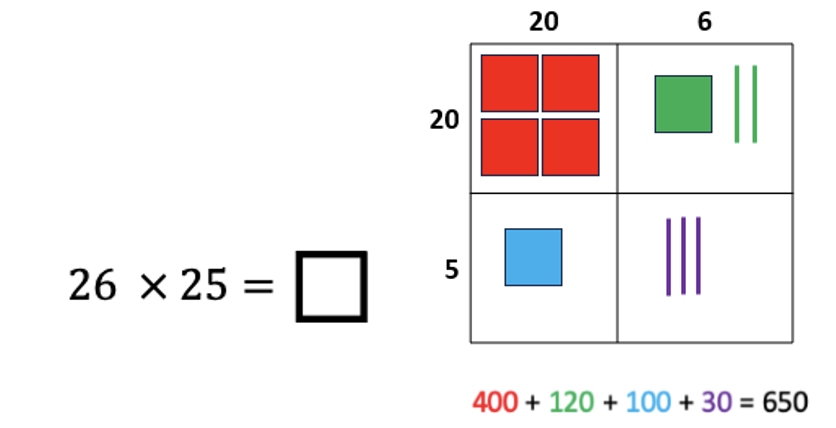
- Additionally, students can use their understanding of base-ten blocks along with place-value strategies to create an area model with pictorials.
- The distributive property can also be used without the organizational structure of the area model.
- For example, when solving the problem 43 X 72, students can show their understanding by setting up the following expression: (40 X 70) + (40 X 2) + (3 X 70) + (3 X 2). Instruction includes helping students understand what each partial product represents and how they are related to using the area model.
Common Misconceptions or Errors
- Students that are taught a standard algorithm without any conceptual understanding will often make mistakes. For students to understand a standard algorithm or any other method, they need to be able to explain the process of the method they chose and why it works. This explanation may include pictures, properties of multiplication, decomposition, etc.
Strategies to Support Tiered Instruction
- Instruction includes explaining mathematical reasoning while solving multiplication problems. Instruction also includes determining if a method was used correctly by reviewing the reasonableness of solutions.
- For example, students determine 5 × 137 using an area model and place value understanding.

-
- For example, students solve 5 × 137 using partitioning and place value understanding.
.png)
-
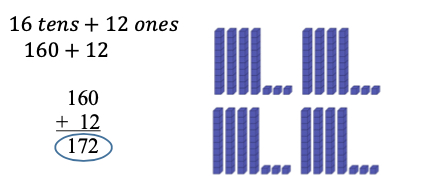
- For example, students determine 4 × 43 using base-ten blocks and place value understanding.
-
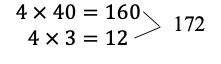
- For example, students determine 4 × 43 using partitioning and place value understanding.
Instructional Tasks
Instructional Task 1
Paul orders tomatoes for The Produce Shop. Each box has 24 tomatoes in it. If Paul orders 32 boxes of tomatoes, how many tomatoes will The Produce Shop have to sell? Use a strategy of your choice to find the number of tomatoes The Produce Shop has to sell. Explain your thinking and why your method works.
Instructional Task 2
Select four cards from the set of cards below.

Part A. Use your cards to create a three-digit number and a one-digit number. Find the product of your three-digit and one-digit numbers.
Part B. Use your cards to create a two-digit number and another two-digit number. Find the product of your two-digit numbers.
Part C. How are your two products similar? How are they different?
Instructional Task 3
Part A. How can you use the product of 75 X 8 to help you find the product of 750 X 8?
Part B: Explain the relationship between the two products from Part A using the words “ten times greater and “ten times less.”
Instructional Items
Instructional Item 1
The product of 57 and 92 is ____.
- a. 627
- b. 4,644
- c. 5,234
- d. 5,244
Instructional Item 2
Which expressions have a product of 2,128? Select all that apply.
- a. 56 X 38
- b. 532 X 4
- c. 44 X 52
- d. 276 X 8
- e. 28 X 76
What is the product of 465 x 32?
*The strategies, tasks and items included in the B1G-M are examples and should not be considered comprehensive.
General Information
Subject Area: Mathematics (B.E.S.T.)
Grade: 4
Strand: Number Sense and Operations
Standard: Build an understanding of operations with multi-digit numbers including decimals.
Date Adopted or Revised: 08/20
Date of Last Rating: 00/00
Status: State Board Approved
This benchmark is part of these courses.