MA.8.GR.1.6

Clarifications
Clarification 1: Problems include representing angle measures as algebraic expressions.
Alternate version of this benchmark for students with significant cognitive disabilities.
Connecting Benchmarks/Horizontal Alignment
Terms from the K-12 Glossary
- Regular Polygon
Vertical Alignment
Previous Benchmarks
Next Benchmarks
Purpose and Instructional Strategies
In grades 6 and 7, students found areas of quadrilaterals and other polygons by decomposing them into triangles and trapezoids. In grade 8, students develop and use formulas for the sums of the interior angles of regular polygons by decomposing them into triangles. In Geometry, students will use this knowledge to prove relationships and theorems about triangles, parallelograms, trapezoids and other polygons.- Once students understand the conceptual understanding associated with this benchmark, students should progress from numerical expressions to algebraic expressions.
- When beginning the exploration with polygons with four or more sides, students should be able to use one vertex to draw diagonals to non-adjacent vertices. Once students have drawn the diagonals, have them cut along the diagonals to showcase triangles.
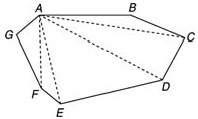
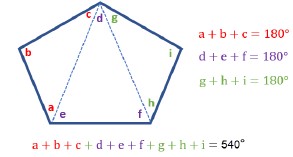
- Once the triangles are cut, then students can lay them out to see the number of triangles and relate the work to prior work with the sum of the angles of a triangle. Students can label their angles and show their equations that help provide information on the sum of the interior angles as shown below.
- Students should record this information in a chart like the one shown below to help them create a rule to use instead of counting the triangles each time.
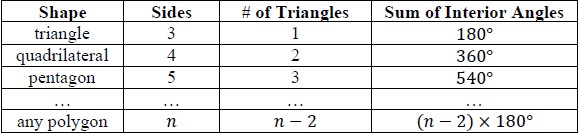
- Once students understand the sum of the interior angles, connections should be made to regular polygons. Students can add a column to indicate the regular polygon measurements of each angle.
- Encourage students to use proper vocabulary terms for polygons and regular polygons.
Common Misconceptions or Errors
- Students may incorrectly draw additional lines from the vertex to create additional triangles.
Strategies to Support Tiered Instruction
- Teacher encourages students to begin at an identified vertex and move around the polygon from that vertex when decomposing the polygons into triangles.
Instructional Tasks
Instructional Task 1 (MTR.5.1)Use your knowledge about shapes to complete the following task.
- Part A. Draw a pentagon, hexagon, heptagon and an octagon.
- Part B. Determine the number of triangles that can be drawn from one vertex to each of the others in each figure.
- Part C. Develop a conjecture to determine if there is a pattern or formula that can be determined to find the sums of the interior angles for any polygon.
Instructional Items
Instructional Item 1Find the number of degrees for the sum of the interior angles of a regular 12-sided figure.
*The strategies, tasks and items included in the B1G-M are examples and should not be considered comprehensive.
General Information
Subject Area: Mathematics (B.E.S.T.)
Grade: 8
Strand: Geometric Reasoning
Standard: Develop an understanding of the Pythagorean Theorem and angle relationships involving triangles.
Date Adopted or Revised: 08/20
Status: State Board Approved
This benchmark is part of these courses.