MA.8.GR.2.1

Given a preimage and image generated by a single transformation, identify the transformation that describes the relationship.
Clarifications
Clarification 1: Within this benchmark, transformations are limited to reflections, translations or rotations of images.
Clarification 2: Instruction focuses on the preservation of congruence so that a figure maps onto a copy of itself.
Alternate version of this benchmark for students with significant cognitive disabilities.
Connecting Benchmarks/Horizontal Alignment
Terms from the K-12 Glossary
- Congruent
- Reflection
- Rigid Transformation
- Rotation
- Translation
Vertical Alignment
Previous Benchmarks
Next Benchmarks
Purpose and Instructional Strategies
In grade 6, students identified the x- or y-axis as lines of reflection. In grade 7, students solved problems involving scale drawings of geometric figures. In grade 8, students are introduced to the geometric transformations of reflection, dilation (scaling) and translation. In Algebra 1, students will describe transformations applied to functions. In Geometry, students will describe transformations given a preimage and an image and represent the transformation algebraically using coordinates. They will use transformations to justify congruence and similarity.
- Informal language such as turns, flips, and slides can be used when exploring the concepts. As students transition, they should use formal mathematical language of rotations, reflections and translations. Students should have materials such as shapes cut from paper to model the transformations.
- Instruction includes the use of real-world examples that don’t have to be a geometric figure.
- For example, wallpaper, art, architecture and mirrors have images generated by simple transformations.
- The work of transformations builds from students being able to visually see the images and developing a spatial understanding as the images move about the coordinate plane.
- Transformations can be noted using the prime notation (′) for the image and its vertices. The preimage and its vertices will not have prime notation.
- For example, the picture below showcases a single transformation.
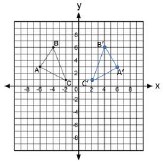
- For example, the picture below showcases a single transformation.
- Problem type include stating which direction, clockwise or counterclockwise, for rotations.
- The expectation of this benchmark is not to represent a transformation on the coordinate plane as this will be included in MA.8.GR.2.3 instruction. During instruction, there should be flexibility moving from this benchmark to MA.8.GR.2.3 with each transformation which allows students to build conceptually prior to algorithmically.
- For mastery of this benchmark, single transformations include one vertical translation or one horizontal translation. A vertical and horizontal translation would be considered two transformations.
Common Misconceptions or Errors
- Students may incorrectly visualize the movement of a figure. To support instruction, students may need manipulatives such as tangrams and tessellations to help with physically moving the figures to understand the transformations.
Strategies to Support Tiered Instruction
- Teacher supports instruction by using manipulatives such as tangrams and tessellations to help with physically moving the figures to understand the transformations.
- Teacher models using geometric software and creates a graphic organizer to understand each transformation with relatable vocabulary.
- Teacher uses example images and preimages to demonstrate the different types of transformation and how to identify images and preimages.
- Teacher encourages the use of manipulatives and models counting the units moved to verify the proper movement of the transformation.
- Instruction includes the use of tracing paper to trace the pre-image and explore possible transformations by slides, rotating, and flipping the image to try to reproduce the image.
Instructional Tasks
Instructional Task 1 (MTR.6.1)
Is it possible to have ΔPRQ make one translation, rotation, or reflection to become the image of ΔABC? Explain why or why it is not possible. Determine which transformation(s) may be used.
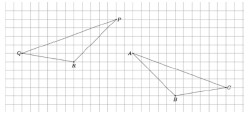
Instructional Items
Instructional Item 1
Determine the transformation from the preimage above line m to the image below line m.
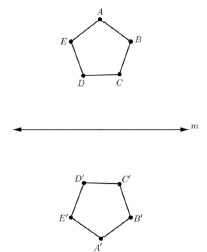
Instructional Item 2
Draw a right triangle labeled with vertices MNO and then sketch the right triangle that has been rotated 90° counterclockwise.
*The strategies, tasks and items included in the B1G-M are examples and should not be considered comprehensive.
General Information
Subject Area: Mathematics (B.E.S.T.)
Grade: 8
Strand: Geometric Reasoning
Standard: Understand similarity and congruence using models and transformations.
Date Adopted or Revised: 08/20
Date of Last Rating: 00/00
Status: State Board Approved
This benchmark is part of these courses.